Weed & Pest Districts, funded by property tax dollars, are the first line of defense in protecting agricultural producers, landowners, and the economy from devastating loss. A common misconception about Weed and Pest Districts is that they are county departments. The fact is, Weed and Pest Districts are Special Districts and were established in 1973 by the Wyoming Weed and Pest Control Act (WS 11-5-101 through 11-5-120). This act established that each county shall have a District funded by the tax levied on all property. Districts have their own boards, appointed by county commissioners, ensuring local priorities are met.
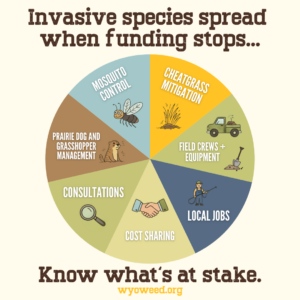
Districts are dependent on the tax levied upon property for base funding. Many are utilizing these funds to leverage additional funding for programs that benefit all landowners. Tens of millions of funds from other sources are unusable without this base district tax funding. Tax reform measures, targeting property taxes, have the potential to erode this critical funding for districts. This is a concern for the ability for districts to carry out the Weed and Pest Control Act. Special districts do not receive sales tax. In addition to impacts on Weed & Pest Districts across the state, funding reductions put much more at stake than many realize—affecting public safety, schools, roads, and other vital services.
Wyoming loses millions of dollars annually in Ag production, recreation/tourism dollars, and wildlife health due to invasive weeds. These costs trickle down into everyday life for all who call Wyoming home. A recent University of Wyoming economic impact study analyzed 10 invasive species and estimated losses of $83.5 million for the State annually. There are dozens more species on state and county lists not accounted for in the study. The University only looked at agricultural impacts from lost forage production due to invasion. Compounding impacts to industry, recreation, and wildlife were not part of this pilot. When all factors are taken into account, the losses are unimaginable. Without the programs that are currently in place to combat these ten invasive species, the number could rise to $351.8 million of annual impact.
52 million acres are at risk if these species are not actively managed. (Current and Potential Economic Impacts of 10 Invasive Weed Species in Wyoming: A pilot study of Agriculture losses; Nagler, Ritten, Mealor: 2024 UW Publication #B-1398)